

Steel Gates in Georgetown, TX

Steel gates in Georgetown, TX are built from tube frames, welded, galvanized and powder coated, then hung on posts set for Williamson County limestone and clay.

What We Cover

Steel Gates in Georgetown, TX

Steel gates in Georgetown, TX work hard. They swing or slide across driveways in Williamson County heat, sit in clay and limestone soil that moves each season, and carry the weight of pickets, panels and sometimes a gate operator. A steel gate that stays square for fifteen years starts with the right tubing, clean welds and posts set below the soil that heaves.

What makes a steel gate last

The frame does most of the work. Tube wall thickness decides whether the leaf resists racking, and the hinge stile is sized heavier than the rest. Continuous welds hold up through the swing from a cold January morning to a July afternoon along Interstate 35. Cross bracing keeps the rectangle true, so the leaf rests on the brace instead of pulling on the hinges.

Posts, footings and the ground

Limestone sits close to the surface in parts of Georgetown and out toward Lake Georgetown and the Texas Hill Country, and expansive clay lies over it in many yards. Posts are set in a deeper bored footing, plumbed on two faces and allowed to cure before a heavy leaf is hung. A post that leans a quarter inch at the top puts the latch an inch out of line at the far end.

Finishes and heat

Galvanizing and powder coat protect steel in different ways, and primer over bare steel needs recoating sooner in Georgetown humidity. Dark finishes run hotter in the sun, so the clearance at the latch and hinge side is set for summer growth. A long leaf gains a fraction of an inch in July, and the gap left in spring decides whether it binds.

Guides

The pages here cover tube wall thickness, galvanizing versus primer, heat expansion, weld quality, post depth in limestone soil and how to judge steel gate work before it starts. Each one is written from the shop and the job site, around Georgetown Square, Sun City Texas and the neighborhoods along the San Gabriel River.

Latest Guides

An iron gate featuring a sun design, set in a tranquil courtyard on a sunny day.

Which hinges hold a heavy steel gate without sagging

2026-11-09

Why do hinges decide whether a steel gate sags?

Black iron gate with decorative bars set between two posts

Hinges carry the whole weight of the leaf and the turning force of every swing, so a weak or badly placed hinge is the first thing to fail on a heavy steel gate. The frame can be perfectly welded and the post perfectly set, and the leaf will still drop at the latch end within a year if the hinges were sized for a lighter gate. In Georgetown, where a leaf may swing thousands of times through summer heat and winter cold snaps, the hinge is the moving part that takes the punishment.

What are the main hinge types used on steel gates?
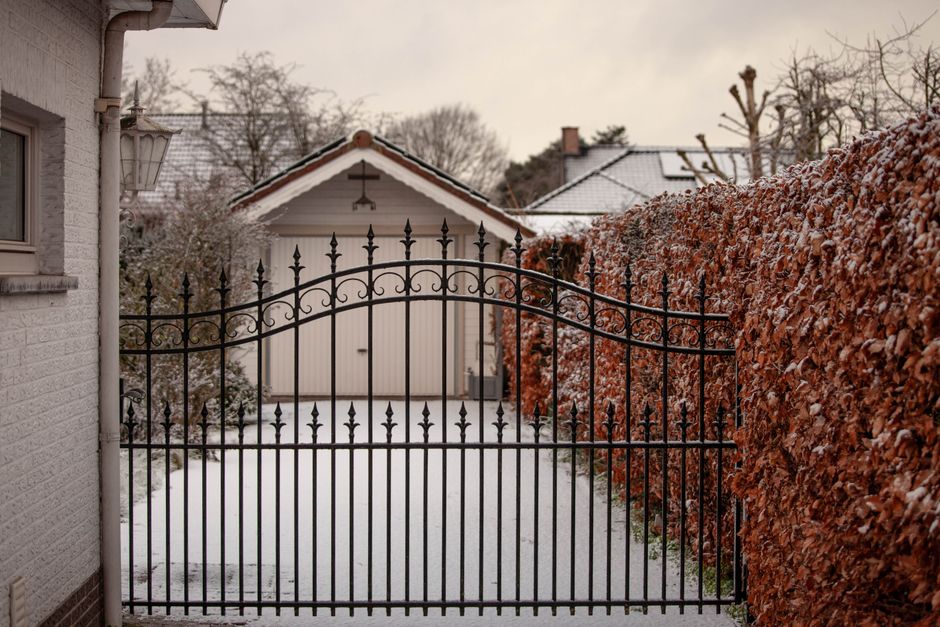
Black iron gate with decorative bars set between two posts

Three families cover most steel gate work: weld on barrel hinges, bolt on adjustable hinges, and heavy duty ball bearing hinges. A barrel hinge is a pin inside a sleeve, welded to the post and the frame. A bolt on hinge uses a threaded eye or a strap so the position can be changed after hanging. A ball bearing hinge carries the weight on a thrust bearing between the knuckles, which keeps the leaf turning easily even when it is heavy. Each type has a weight range where it works well and a range where it does not.

How do barrel hinges behave on a long driveway leaf?

Barrel hinges are simple and strong, but they wear where the pin rides inside the sleeve. On a light pedestrian gate that wear takes years to matter. On a driveway leaf that weighs a few hundred pounds, the sleeve ovals out, the leaf drops a little, and the latch begins to miss its keeper. Grease helps, and a greased fitting on the hinge lets the owner keep the pin lubricated. A washer or a thrust cap at the bottom of the knuckle keeps the leaf from grinding straight down onto the lower hinge.

When is a ball bearing hinge worth the trouble?

A ball bearing hinge is worth using whenever the leaf is heavy, long or fitted with an operator arm. The bearing takes the vertical load without friction, so the leaf swings freely and the operator does not strain against drag. Heavy solid panel gates, tall privacy leaves and gates with dense ornamental infill all fall into that group. The extra cost of the hardware is small compared with the cost of pulling a leaf, replacing a worn sleeve and re-welding a hinge stile.

How big should the hinge pin be?

The pin diameter should match the weight and the leaf width, with five eighths of an inch a common minimum for a driveway leaf and three quarters of an inch or more for a wide one. A pin that is too thin bends slightly under load, and that bend turns into slop. Hinge knuckles also need enough length to spread the load into the frame. A short knuckle on a heavy leaf concentrates the stress at one spot on the stile, where a crack will start along the weld.

Where do hinges go on the leaf?

Hinges go as far apart as the leaf height allows, usually a few inches in from the top and bottom rails, because the wider the spread the less force each hinge carries. A tall leaf with hinges close together acts like a lever, and the top hinge pulls out of the post while the bottom hinge pushes in. On a leaf taller than six feet, a third hinge at the middle rail helps keep a long vertical stile straight. The hinges also line up on a single vertical axis, since an axis that leans even slightly makes the leaf swing open or closed by itself.

Why does the hinge axis need to be plumb?

The hinge axis must be plumb because gravity pulls on any leaf that swings around a tilted line. A leaf hung on a post that leans toward the drive swings shut on its own, and a leaf on a post that leans away swings open. Some crews tilt the axis on purpose by a hair to help a gate close, but that setting needs a careful hand. Most of the time a plumb pair of hinges, checked with a level on both faces of the post, gives the calm, even swing that people expect.

How does the post change the hinge choice?

The post sets the limit on how much the hinge can hold, because a hinge is only as secure as the steel or masonry behind it. A square steel post with a thick wall takes a welded hinge well. A hollow brick column cannot carry a heavy leaf at all unless a steel post is cast inside it. In clay soil around Georgetown that moves with the weather, a post that shifts even a quarter inch at the top changes the hinge angle at the bottom. That is why the footing and the hinge are planned together.

What does adjustability add?

An adjustable hinge lets a crew fix a leaf that has dropped or twisted without cutting any steel. A threaded eye lets the leaf be raised or lowered by turning a nut, and a slotted strap lets it move toward or away from the post. Over the first season a new gate settles, and a few turns on the adjusters bring the latch back to the center of the keeper. A fixed weld on hinge leaves no such room, so any change after the first year means grinding and re-welding.

What are the early signs of a failing hinge?

The early signs are a squeak, a leaf that drags at the bottom corner, a latch that no longer lines up, and a dark streak of rust dust under the knuckle. Each sign means the pin or the sleeve is wearing and the leaf is sinking a little with each swing. Catching it early costs a grease fitting and a washer. Waiting until the leaf scrapes the driveway means a bent hinge stile and often a new pin and sleeve on both hinges.

How does finish affect a hinge?

A hinge needs a finish that lets it move, so the knuckle surfaces stay bare and greased while the rest of the hardware is galvanized or coated. Paint that runs into the knuckle seizes the pin in the first humid week. Powder coat on the weld on parts is fine, but the bearing faces are masked before the gate goes into the oven. Stainless pins in a galvanized sleeve resist the rust that locks a plain steel pin in place during a damp spring along the San Gabriel River.

How is a sagging leaf corrected?

A sagging leaf is corrected by finding which part has moved: the post, the hinge or the frame. The crew props the leaf at its correct height, checks the post with a level, inspects the sleeve and pin for wear, and looks for a crack in the stile weld. If the post leans, the footing is the problem and no hinge adjustment will hold. If the sleeve is worn, a new pin and bushing restore the swing. If the frame has racked, a diagonal brace is added and the corners are re-welded square.

What should be checked every year?

  • Grease each hinge fitting and wipe the old grease from the knuckle.
  • Check the leaf height at the latch end against a mark made when the gate was new.
  • Look at the hinge welds for hairline cracks and rust staining.
  • Plumb the post and compare it with last year.
  • Open the gate by hand and listen for a grind or a catch.

A short yearly check takes about ten minutes and catches almost every hinge problem before it turns into a repair.

How do hinges and a gate operator work together?

An operator arm pushes the leaf from the hinge side, so the hinge takes extra side force on top of the weight. A heavy ball bearing hinge handles that force with little drag, while a worn barrel hinge makes the motor work harder and trip its limit. Crews that plan an operator from the start choose the hinge, the post size and the arm mounting together, which saves a retrofit later. Around Sun City Texas, where many gates are automatic from day one, that planning shows in how quietly the leaf moves.

What is the simple way to choose?

Pick the hinge by the weight and width of the leaf, then size the pin and post to match. A light pedestrian gate does fine on barrel hinges. A heavy driveway leaf wants ball bearing hinges, a thick pin, wide spacing and a post set deep below the clay. Spend the effort on the hinges early, because they are the one part that cannot be hidden when it fails.


Read more →

Artistic shot of a vintage rusty gate against a vivid blue sky with a bird flying overhead.

How is a driveway opening measured for a steel gate

2026-11-09

A driveway opening is measured at three heights and two ends, and one tape pull across the top does not count as a measurement. A gate that looks fine on paper binds on the ground when the opening is wider at the bottom than at the rail line, and Georgetown driveways cut into limestone and clay move enough to make that common.

Why does one measurement fall short?

A vintage rusty metal gate set against a classic brick wall, offering a glimpse into a hidden garden.

Posts rarely stand perfectly parallel. Brick pillars lean, wooden posts twist, and an older fence line drifts a little with every season of wet and dry clay. A tape stretched at chest height gives one number, and the gate will be built to that number. When the bottom of the opening is an inch narrower, the leaf scrapes the pillar on the way open. Three readings, one near the ground, one at mid height and one at the top rail line, show the real shape of the opening.

What tools make the readings trustworthy?

Close-up of a vintage iron gate with a 'Please Close the Gate' sign in black and white.

A steel tape, a four foot level, a plumb bob or a laser line, a string line and a notepad cover the work. The tape is held tight and read at the same point on each post, with the end hooked on something solid instead of pinched by hand. The level checks each post for lean in both directions. A string line stretched between the posts shows whether the opening runs straight or curves across the drive.

How does grade change the swing?

Driveways in Williamson County rarely lie flat. A drive that rises toward the street lifts the bottom rail of a swing gate as it opens, so the leaf must clear the highest point on its arc. The crew measures the rise across the full swing distance, then adds clearance on top of that number. When the slope is steep, the leaf may be hung to open only inward, or built as a slide gate or a cantilever gate that never touches the pavement.

What clearances are written down?

The notes list the gap at the hinge side, the gap at the latch side and the gap under the bottom rail. A typical swing gate leaves about an inch under the rail on a flat drive, and more on a slope. Summer heat lengthens steel, so the latch gap is set wider than it would be for a gate that never saw sun. Where two leaves meet in a dual swing pair, the center gap is recorded as its own line.

Which numbers go in the notes for the posts?

The notes list the post size, the post spacing, the depth of the existing footing if it can be seen, and the type of soil. Limestone near the surface changes how the post holes are drilled. Expansive clay near Lake Georgetown changes how deep the footing runs. Existing masonry columns are tapped and checked for hollow spots, since a column that sounds hollow cannot carry a hinge.

What about the swing direction and clearance?

A leaf that swings into the property needs a clear arc, free of shrubs, mailboxes, planters and the slope of a front walk. The arc is marked on the ground with chalk or spray paint, at full open, and walked. A leaf that swings out toward the street needs the setback to be checked against the local rules, which differ between city lots, Sun City Texas, and rural lots on the edge of the county.

How does an operator change the plan?

A gate operator needs power, a mounting surface and room for the arm to travel. The measurement visit notes where the nearest power source sits, how far the conduit would run, and whether the post is large enough to carry the arm. A swing operator on a small post will pull it out of plumb within a season. Where a slide gate is planned, the runway is measured at least as long as the opening plus the width of the tail.

What is checked on the day of the visit?

  • Opening width at the ground, mid height and top rail line, at both ends.
  • Lean of each post, front to back and side to side.
  • Grade rise across the full swing arc.
  • Soil type, and whether rock shows at the surface.
  • Location of power, water lines and underground utilities.
  • Swing direction, obstructions and the setback from the street.

Which mistakes show up after the gate is built?

The most common mistake is trusting the opening width from a photo or a rough drawing. The second is ignoring grade, which leaves the bottom rail scraping the pavement. The third is skipping the post check, and hanging a heavy steel frame on a column that was never meant to carry one. Each of these costs a second trip, a new set of welds or a reset footing, and each shows up in the first few days of use.

How long should the measurement visit take?

Around Georgetown Square, where older lots and narrow drives are common, a careful visit takes about an hour for a single swing gate. A dual swing pair across a wide opening, with a slope and a planned operator, takes longer. A visit that wraps up in ten minutes with one tape pull is a visit that will leave questions for the install day.

What happens after the numbers are in?

The numbers go into a drawing that shows the leaf size, the gaps, the post positions and the hinge locations. The tube sizes and wall thickness are chosen from the span and the weight of the infill. The drawing is checked against the notes before any steel is cut, and the customer sees the dimensions before the frame is built. A drawing approved with the real numbers rarely needs changes at the shop.

How are the numbers double checked?

Every reading is taken twice, once going up the opening and once coming back down, and the two sets are compared before leaving. A difference of more than an eighth of an inch means the tape slipped or the post is moving, and that reading is retaken. The diagonal across the opening is also measured corner to corner, because a rectangle with equal diagonals is square, and a gate built to a square opening that is not square will always show a wedge shaped gap along one edge. Photos are taken of each post base, the soil, the grade and the planned operator location, so the shop has the same view the crew had on site and no detail depends on memory.

What are the hinge and latch positions based on?

The hinge post is chosen first, because it carries the load and the twist. The stronger and plumber of the two posts takes the hinges. The latch post only needs to stay put and hold the keeper in line with the latch bolt. If the stronger post is on the wrong side for the swing, the crew swaps the swing direction on the drawing before the shop cuts anything, since moving a hinge post after the frame is built means a new frame.

Is a second visit ever needed?

A second visit is common when the first visit finds something unexpected, such as buried rock, an old footing that needs removal or a utility line close to the planned post. The crew marks the spots, calls for the utility locate in Williamson County, and returns once the locate is complete. Skipping the locate and drilling anyway can cut a line, and no gate is worth that repair.

Read more →

Nearby Service Areas

We also cover steel gates in Austin, TX.